Why is laser cutting preferred over mechanical cutting in precision manufacturing?
Laser cutting is often preferred over mechanical cutting in precision manufacturing when buyers need accurate sheet profiles, complex contours, small features, repeatable nesting, and limited mechanical force on the material. This FAQ compares laser cutting with mechanical cutting for sheet metal brackets, panels, enclosures, covers, gaskets, and precision blanks, and explains what RFQ details help buyers choose the right cutting route.
Why is laser cutting preferred over mechanical cutting in precision manufacturing?
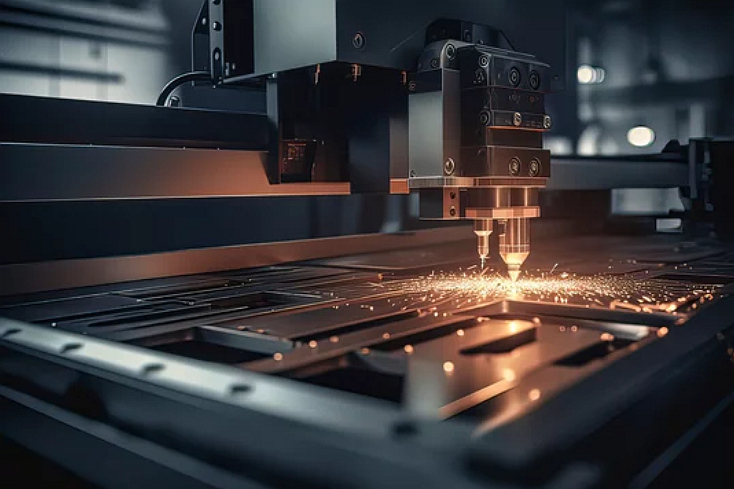
Laser cutting is preferred in many precision manufacturing projects because it is a non-contact process that can cut complex flat profiles without tool pressure, tool wear, or cutting-tool deflection. This helps with intricate outlines, dense nesting, small slots, and parts that would be difficult to punch, shear, saw, or mill efficiently.
The preference is not universal. Mechanical cutting, punching, stamping, sawing, or CNC machining may still be better for certain thick sections, simple straight cuts, high-volume stamped parts, precision machined features, or materials that do not respond well to laser energy. The RFQ should compare part geometry, material, volume, edge quality, burr tolerance, and downstream operations.
Buyer decision factor | Laser cutting advantage | Mechanical cutting consideration |
|---|---|---|
Complex flat geometry | Cuts curves, slots, holes, and nested profiles without custom hard tooling | Punching or stamping may need dedicated tooling for repeated shapes |
Mechanical force | No cutting-tool pressure, which can reduce clamping damage and tool deflection risk | Shearing, punching, or milling can introduce stress, burrs, or deformation |
Design changes | Program updates can support prototype and low-volume revisions | Hard tooling changes may add cost or delay for revised geometries |
Edge and burr control | Can produce clean edges when material, assist gas, and parameters are suitable | May require deburring, tool maintenance, or secondary finishing |
Functional precision | Useful for accurate profiles, hole patterns, panels, and flat blanks | CNC machining may still be needed for precision datums, threads, and bearing features |
How does non-contact cutting help precision sheet metal parts?
Non-contact cutting helps because the laser does not push a blade, punch, or end mill through the material. This can reduce tool deflection, fixture stress, and mechanical deformation on thin sheet profiles, fine webs, narrow slots, and detailed outlines.
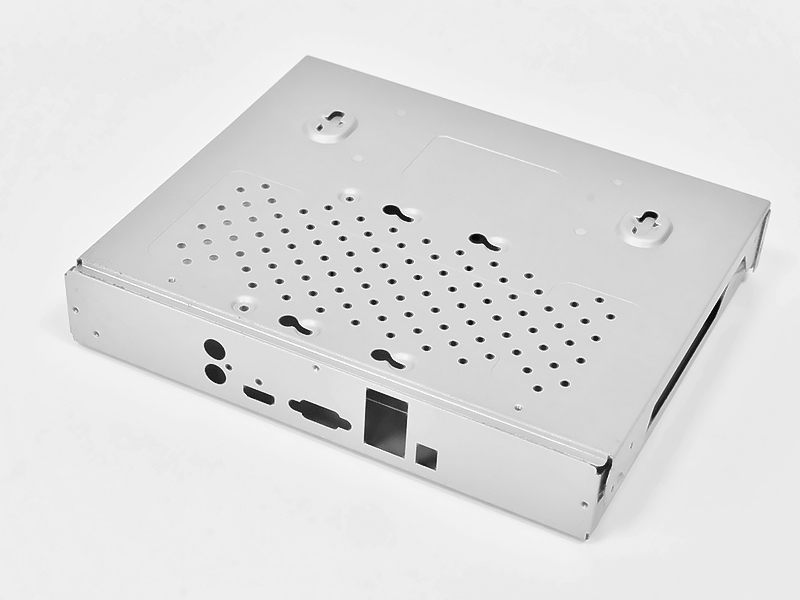
For sheet metal fabrication, this matters when the laser-cut blank will later be bent, welded, coated, or assembled. Buyers should mark bend lines, tabs, datum edges, holes, and cosmetic edges so the supplier can plan cutting sequence, nesting, and secondary operations.
Why is laser cutting useful for complex contours and design revisions?
Laser cutting is useful for complex contours because the toolpath is software-driven. Curves, hole arrays, slots, perforations, brackets, vent patterns, logos, and panel outlines can often be adjusted without building a new punch or stamping die.
This makes laser cutting practical for prototypes, bridge production, and high-mix low-volume parts. Buyers in consumer electronics, telecommunication, medical-device equipment, and automotive programs should state whether the design is still changing or ready for production tooling.
How do burrs, edge quality, and heat distortion affect the choice?
Laser cutting can reduce some mechanical burr and tool-mark risks, but the laser process can still create heat-affected edges, dross, discoloration, edge taper, or distortion if material and parameters are not controlled. Mechanical cutting can create burrs, tool marks, rollover, or deformation depending on the process and tool condition.
The RFQ should define acceptable burr level, edge appearance, oxide edge preference, flatness, cosmetic surfaces, and whether the part will be painted, welded, plated, anodized, or powder coated. If edge quality is a functional requirement, the inspection method should be specified.
When is mechanical cutting or CNC machining still the better choice?
Mechanical cutting may be better for simple straight cuts, very high-volume blanking with established tooling, or materials that are not safe or practical for laser cutting. CNC machining may be better when the part needs tight 3D features, precise counterbores, bearing seats, threads, flat machined datums, or thick-section material removal.
Buyers should separate flat profile requirements from machined feature requirements. A laser can cut the outline of a bracket, but a precision threaded hole, sealing surface, or bearing pocket may still need machining after cutting.
What RFQ information helps compare laser cutting and mechanical cutting?
A useful RFQ includes material grade, sheet thickness, 2D drawing, 3D model if needed, quantity, tolerance notes, critical holes, edge quality, burr limits, flatness, surface finish, bend or weld requirements, and inspection method. The buyer should also state whether design changes are expected or whether the part is ready for production.
With those details, the supplier can compare laser cutting, punching, shearing, sawing, stamping, waterjet cutting, or CNC machining by cost, risk, edge quality, dimensional control, and downstream manufacturing. The best process is the one that meets the final part function with the lowest practical manufacturing risk.
Related FAQs